
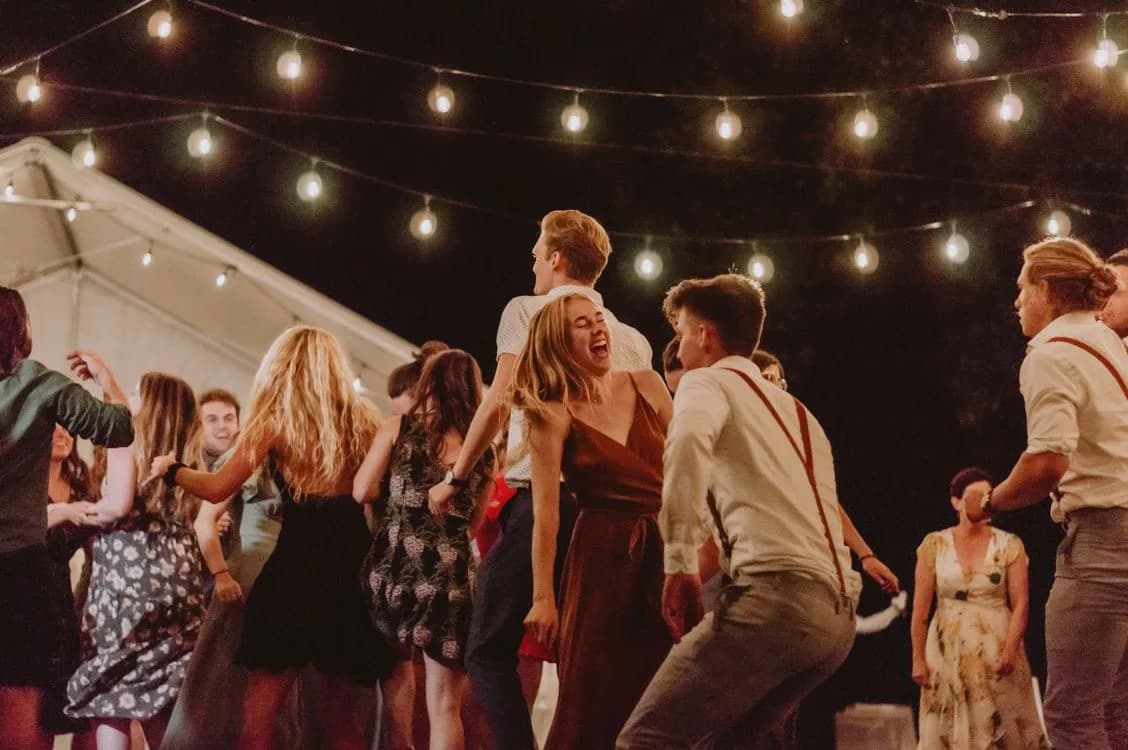
Summer in Little Rock means outdoor events. Pool parties, rooftop receptions, garden celebrations, outdoor brand activations, graduation parties that spill into the backyard. And while the visual appeal of an outdoor event in Central Arkansas on a good June evening is hard to beat, the audio picture is a completely different challenge from anything indoors.
Here's what actually changes when you DJ outside — and what to plan for to make sure your summer event sounds as good as it looks.
Why outdoor audio is harder than it seems
Indoors, walls and ceilings contain the sound. The room works with you. Outdoors, there are no walls — sound disperses in every direction and loses intensity fast. The result is that covering an outdoor space with good-quality audio requires more equipment, more careful placement, and a different approach to the mix than any indoor event.
A few specific challenges that come up in every outdoor DJ setup:
Coverage over distance. A single pair of speakers pointed at the crowd might cover 50 feet well and sound thin at 80. For larger outdoor spaces, additional speakers or a distributed setup fills in the gaps — but it requires planning and the right gear.
Ambient noise competition. Wind, traffic, crowd chatter, and whatever's happening at the neighboring property all compete with the music outdoors in a way they don't inside. A DJ playing outside has to mix with a higher baseline noise floor, which changes how the music lands.
Wind and its effects. Wind isn't just a comfort issue — it affects sound propagation and, on a bad day, equipment stability. Speaker stands, cables, and anything not anchored down need to be secured. I always build in extra setup time for outdoor events in the summer months.
Temperature and humidity. Arkansas summers are hot and humid. Electronic equipment generates heat, and the ambient conditions add to it. Equipment that runs fine in a climate-controlled room can run warm outdoors. Professional gear handles this well; budget gear doesn't always.
Power access. Outdoor venues — especially private residential properties and pop-up event spaces — often have limited or awkward power access. Generator requirements, outdoor-rated extension cables, and circuit capacity all need to be confirmed before the event, not discovered at load-in.
Equipment considerations for outdoor events
The setup for an outdoor event in Little Rock is different from an indoor one, and the differences matter:
Speaker selection. Outdoor setups benefit from speakers with wider horizontal dispersion — sound that spreads across the crowd rather than throwing in a narrow beam. Line array setups are ideal for larger outdoor events; they're designed specifically for wide, even coverage.
Subwoofer placement. Bass frequencies are directional outdoors in a way they aren't inside. Subwoofer placement matters more, and the low end often needs to be pushed harder to feel present at a distance.
Cable management. Outdoor setups involve longer cable runs over uneven terrain. Gaffer tape, cable ramps, and clean routing aren't just about aesthetics — they're safety. Nobody wants to trip over a cable on the dance floor.
Backup power planning. If the event is at a residential property or a venue without dedicated circuits, generator backup is worth having. I bring a generator for outdoor events where power reliability is uncertain.
Summer events that work well outdoors in Little Rock
Pool parties and backyard celebrations. The most common outdoor summer event in Little Rock. The key is matching the audio setup to the actual space — a backyard party for 40 people needs a completely different setup than a pool party for 150. Getting this right starts with a conversation about the space before the event. For everything to consider when planning one, see Private Party DJ in Little Rock or DJ AJ's private party services in Little Rock.
Rooftop receptions and terrace events. Several properties in the River Market area and around downtown Little Rock have outdoor terrace or rooftop event space. These venues tend to be windier and more acoustically complex than ground-level outdoor events, but they deliver views and atmosphere that's hard to match indoors. They're ideal for evening receptions, outdoor corporate events, and brand activations that want a social-media-worthy backdrop.
Graduation parties. Late May through June is the heart of graduation season in Central Arkansas. Many of these events happen at private homes with outdoor space. The planning logistics are simple — the main thing is getting a clear picture of the outdoor space, power situation, and expected guest count before you book.
Brand activations and boutique pop-ups. Outdoor brand events have grown significantly in Little Rock over the last few years. A pop-up in a parking lot or outdoor courtyard with a live DJ creates a social event out of what would otherwise be a shopping experience. For more on what makes these events work musically, see DJ for a Boutique Opening or Brand Event in Little Rock.
What to tell your DJ before an outdoor summer event
The more specific the pre-event information, the better the setup. Before any outdoor event in Little Rock, your DJ needs to know:
- The exact location. Address, whether there's parking or load-in access close to the event area, any distance between parking and the setup point.
- The outdoor space dimensions. Rough length and width of the area where guests will be. This determines speaker requirements.
- Power access. Where the outlets are, how many circuits, whether there's a panel nearby, and whether generator backup might be needed.
- Time constraints. Setup time, sound check time, event start and end time. Outdoor setups take longer than indoor setups. Build in at least 90 minutes for load-in.
- Any noise restrictions. Neighborhood ordinances, venue rules, or HOA restrictions that affect volume or end time.
- Weather contingencies. What happens if it rains? Is there a covered backup plan? Does the event move inside, get postponed, or push through?
A note on summer heat and timing
A practical one: outdoor summer events in Little Rock that run entirely during the hottest part of the day (noon to 5pm in July) are harder on guests, vendors, and equipment than evening events. If you have flexibility on timing, evening starts — 6pm or later — make for a much better outdoor event in the Arkansas summer. The temperature drops, the lighting gets interesting, and people stay longer because they're not melting.
If a daytime event is unavoidable, shade for the DJ setup specifically is worth prioritizing. Direct sun on equipment for four hours is not ideal.
Planning a summer outdoor event in Little Rock? Check DJ AJ's availability and let's talk through the setup — I'll ask the right questions about your space and build a rig that's right for the environment.